90-year-old lynching: Suspects rearrested after court discharge

KafabaThe 90-year-old woman was beaten to death after being labelled a witch

Suspects in the murder of 90-year-old Akua Denteh at Kafaba in the East Gonja Municipality reappeared in the Bole magistrate court on Thursday August 20, 2020.

Presiding over the case, the judge at the Bole Magistrate Court His Worship Andrew Prince Cudjoe discharged the accused on their earlier charge sheets but they were rearrested.

The judge directed the police to remand the accused persons to police custody until the next hearing on the 18th of September.

The suspects were arrested on different days and on different charge sheets but the case is now Consolidated into one charge sheet known as the Republic vrs Haruna Aness and fourten (14) others.

Explaining the process to local Radio Station Nkilgi fm at the court, the Chief State Attorney of the Office of the Attorney General in-charge of Northern, Savannah and North East regions, Mr Salia Abdul-Kudus said the accused persons have been discharged on the former charges and the cases consolidated into one case to enable all stakeholders to speed up action on the case and deliver justice.

He added that the docket will be sent to the office of the Attorney General in Tamale for perusal within the next one week from 20th August 2020 after which they will be arraigned before a Tamale High court.

Mr. Abdul- Kudus said the accused persons are being tried for a capital offence which is murder and that the Bole Magistrate court cannot give the accused persons bail hence the court remanding them into police custody again.

Seven (7) out of the fourteen accused persons are in police custody while seven (7) are at large.

He said they will be committed by the Bole court to a High Court in Tamale and that by the middle of September the case will be heard at a Tamale High Court.

Scores of residents of Bole trooped to the court premises to catch a glimpse of the accused persons linked to the killing of the 90-year-old woman.

There was heavy security at the court premises to ensure the safety and protection of the accused persons.

Source: Kasapa FM

Money for pad’ and hunger luring Ajumako girls into early sex

1.18656561Money and hunger have caused young girls to have early sexual encounters

The inability of parents and guidance to buy sanitary pads and properly feed young girls have been identified as key factors pushing young girls to engage in unprotected sex in the Ajumako-Enyan-Essiam District of the Central Region.

Some parents have neglected their core responsibility of caring for their children’s basic needs like food, medical care, shelter, clothing, love, attention, understanding, acceptance, quality time, and support.

Therefore, such space had been occupied by some unscrupulous men who use girls as sexual objects under the guise of buying them pad and providing money for food and other personal belongings as their parents looked on helplessly.

These came to light at a sensitisation programme for some selected adolescent girls, boys and parents on the implications of unprotected sex, sexual and gender-based violence, domestic violence and reproductive health issues at Ajumako-Bisease on Tuesday.

It was put together by the Central Regional Department of Gender in collaboration with the Regional Coordinating Council and supported by the United Nations Population Fund (UNFPA).

According to the girls, high rate of unemployment among their parents had resulted in abject poverty, forcing their parents to shirk their obligations, leaving them at the sexual pleasures of unscrupulous men who lured them into unprotected sex leading to teenage pregnancies.

They explained that the situation had created a vicious cycle where young poor semi-educated girls have become premature poor mothers at the expense of their education and development.

“I have a friend whose parents have almost given her in marriage to a taxi driver who takes care of her. Others engage in disguised prostitution as income generating ventures to feed their families,” says Lydia Ankrah, a-15-year-old girl.

She added that many girls face considerable pressure to marry early in their communities to prove their fertility and also to ease the responsibility of their parents in their upkeep.

Ernestina Aidoo, a-14-year old girl said her 52-year-old poor single mother could not afford to buy sanitary pad for her, so she had to used strips of cloth instead, anytime she was menstruating, a situation she said was sometimes unhygienic.

“I can’t blame my mother for giving me strips of cloth as pad because that is the best she can afford. Eventually, when the situation become unbearable, my mother forced me into unprotected sex with a-32-year old famer who occasionally gives me between 5 and 10 cedis.” Florence Mensah, a-16-year-old, giving account of her personal experiences said her parents’ inability to care for her forced her to bow to incessant pressure from one of her school mates who later broke her virginity.

“I know friends who are in relationship with men as old as their father,” she added.

Generally, the young girls stressed the need for them to be empowered for them to be assertive and take bold decisions about their bodies, future and have access to appropriate healthcare services.

They urged parents and guardians to find some work doing to enable them invest in the education of their children and to train them well to help check delinquency and bad adolescents behavior.

According to the young girls, efforts to curb teenage pregnancies and end child marriages will help in retention of girls in school, adding that the authorities should also focus on empowering girls who cannot continue schooling economically, to learn trades of their choice.

They should also enforce laws on child marriage and effectively design tailored advocacy programs to educate key stakeholders and adolescent girls on the consequences of teenage pregnancy.

Additionally, there was the need to address socio-cultural norms, practices to help end child marriage.

Ms. Esther Amankwa, acting District Director of Health for Ajumako who corroborated the stories of the girls, decried the worrying trend of teen pregnancies in the District.

She mentioned other factors to include parental irresponsibility, poverty, unemployment, lack of understanding of adolescent reproductive health issues and assertiveness, illiteracy and low self-esteem among adolescent young girls.

Others are decreasing age of puberty, early age of sexual debut, early marriage, low use of contraceptives and lack of knowledge about sex and family planning.

To reverse the trend, she called for a collective effort to preventing adolescent pregnancy, intensified sex education and strongly encourage abstinence or contraceptive use.

Terrified by the experiences of the young girls, Mrs Thywill Eyra Kpe, Central Regional Director of the Department of Gender with support from UNFPA, distributed quantities of sanitary pads to girls as a temporarily remedy to the situation.

She encouraged the youth to be determined to succeed in life and avoid all tendencies that derailed them.

Mr Alan Paintsil, a Director at the Central Regional Coordinating Council, urged the participants to avoid bad friends who will lead them astray and take their lessons seriously.

Source: GNA

FACT CHECK: Trending video alleging Somalia’s president in fisticuffs with deputy is false

A TRENDING video posted on microblogging site, Twitter by Nana Kwame Ahoufe, a Ghanaian Television presenter that the president of Somalia and his vice-president are engaged in fisticuffs is false.

Nana’s, twitter profile states that he is a TV Director & TV Presenter at Citi TV, a privately owned multi-platform network based in Adabraka, Accra.

He had tweeted the video with an accompanying text that read, “The President of Somalia and his Vice President in fisticuffs! Exchanging executive blows for the good of their country maybe?,” he wrote on Twitter.

The tweet has since gone viral. Nana’s 11 seconds video has now been viewed more than 2000 times, with 701 retweets and comments, 439 likes.

The video has also been picked up and published by some blogs in Nigeria such as Elombah News. Vanguard Newspaper also reported it with a headline, “A President, his Vice, ‘exchange blows’ in public”.

Findings

To verify the authenticity of the video, The ICIR did google and youtube searches and also used google translate in searching for the meaning of Golaha Wakiilada and did a google search on the flag that appeared on the video.

Golaha Wakiilada means of House of Representatives in Somali language, which is the lower house of the de facto state of Somaliland.

The green and red flag with a black star that appeared in the video is that of Somaliland.

Somaliland, officially the Republic of Somaliland, is a self-declared state, internationally considered to be part of Somalia.

Somaliland is a breakaway region on the coast of the Gulf of Aden, Somaliland declared independence after the overthrow of Somali military dictator Siad Barre in 1991.

A Google video search showed that the 20-minute long video appeared on youtube on the 12 of September 2015 on a Somali youtube channel, Dhamays Media Production, with an English translated caption of “Watch the War on the Speaker of the House of Representatives of Somaliland”, having 1,424,316 views, Somali Star Tv, (14 minutes 37 seconds) with 86,967 views, and on 2Qumac, (9 minutes 49 seconds) on the 13th of September 2015 with 246,273 views.

A Google translate of the caption that accompanied the video on 2Qumac read, “How did the Somaliland House of Representative’s scandal start?”

Another caption under the video indicated that the fight was between Chairman Irro and his deputy Bashe.

Abdirahman Mohamed Abdullahi (Irro) is a Somaliland politician who was the 4th Speaker of the Somaliland House of Representatives.

Bashe Mohamed Farah Irro then deputy is the 5th and current Speaker of the Somaliland House of Representatives.

Somalia’s government officially comprises the executive branch of government, with the parliament serving as the legislative branch. It is headed by the President of Somalia, to whom the Council of Ministers reports through the Prime Minister.

Somalia practises a Federal Parliamentary system of government which is currently headed by Mohamed Abdullahi Mohamed who is also the current President of Somalia, and Mahdi Mohammed Gulaid, the Prime Minister.

Somalia currently does not have an office of Deputy President. The last officially recognised Somalian vice president was Siad Barre, ousted in 1991.

VERDICT

Nana’s claim that the viral video is of the Somalian president and his deputy is false. The Federal government of Somalia currently has no office for deputy president. Also, “Golaha Wakiilada” which appeared on the video is the Somali language for House of Representatives (Somaliland) when translated to English, and the flag that appeared on the video is that of Somaliland and not Somalia.

Watch video below>>>

Source:www.icirnigeria.org/

13-year-old girl rescued from rapist during jogging

Rape Skidl

A farmer nearby heard the screams of the girl who had been abducted and rescued her

A 13-year-old girl was rescued Saturday morning around 5:20 am from a man who attempted to defile her while jogging on the Akyem Osiem to Ettukrom road in the Abuakwa South Municipality of the Eastern Region.

The suspect who was riding a motorbike, according to reports, abducted the victim into a nearby bush in an attempt to defile her but she screamed for help which attracted a farmer who had just arrived in a nearby farm to rush to the scene.

The suspect upon seeing the farmer approaching the scene took to his heels and left his motorbike behind.

The victim was sent to the Osiem Police Station together with the impounded motorbike of the suspect.

The owner of the motorbike now at large has been identified as a married man who stays in Akyem Osiem Community.

His wife and brother have confirmed to Police that the motorbike belongs to the suspect (name withheld) who left home at dawn.

The local Police have launched a manhunt for his arrest.

Source: Starr FM

Education Minister discloses when schools will reopen in Ghana

Minister of Education, Dr Matthew Opoku Prempeh

Minister of Education, Dr Matthew Opoku Prempeh, has said the reopening of schools in Ghana will be dependent largely on how the coronavirus behaves in the country.

Asked when schools will reopen while speaking in an interview with Berla Mundi on the COVID-19 360 on TV3 Thursday, August 13, Dr Opoku Prempeh said, “we will go back to school if the virus allows us.”

He explained that the decision will be based on the available science and data on the Covid-19 situation in the country.

“So depending on the science and data, we will reopen schools. We reopened schools for final years as they maintain social distancing,” he said.

He observed when schools reopened for final students to write their examinations, the government suffered flak from people.

However these same people, he said, are now calling for all schools to reopen.

“Had it not been that the government was sound of what it was doing they would have given up. All these people saying we should open schools, those people will not be going to be there if we open and an incident happens,” he said.

Dr Opoku Prempeh earlier tested positive for the coronavirus but was treated and declared healed.

However, he said he is unsure whether he has fully recovered from the Coronavirus infection he contracted or not. He believed recovered enough to resume work.

“It was an experience I have said repeatedly that I don’t even wish for my enemy.”

He said it was after he experienced the disease that he came to the reality that, indeed, “Coronavirus is here with us”.

For him, Ghanaians must take all the safety protocols seriously as “it is not a situation I would want anybody to get into”.

He recounts that despite feeling a little bit of malaise about 10 days before he was hospitalised, he got tested for the virus upon advice from close associates but the result came out negative.

He said after returning from his acclamation as the Manhyia South parliamentary candidate of the New Patriotic Party (NPP), he decided to voluntarily take some tests at the UGMC, having gone there to visit a relative admitted for Covid-19.

He said he was there for two weeks, during which same period he heard about the death of the Chief Executive Officer of the Forestry Commission, Kwadwo Owusu Afriyie who also contracted the virus.

Dr Opoku Prempeh confessed that he had the belief that he would survive after that close shave with death.

Source: 3 News

Education Minister discloses when schools will reopen.

Minister of Education, Dr Matthew Opoku Prempeh

Minister of Education, Dr Matthew Opoku Prempeh, has said the reopening of schools in Ghana will be dependent largely on how the coronavirus behaves in the country.

Asked when schools will reopen while speaking in an interview with Berla Mundi on the COVID-19 360 on TV3 Thursday, August 13, Dr Opoku Prempeh said, “we will go back to school if the virus allows us.”

He explained that the decision will be based on the available science and data on the Covid-19 situation in the country.

“So depending on the science and data, we will reopen schools. We reopened schools for final years as they maintain social distancing,” he said.

He observed when schools reopened for final students to write their examinations, the government suffered flak from people.

However these same people, he said, are now calling for all schools to reopen.

“Had it not been that the government was sound of what it was doing they would have given up. All these people saying we should open schools, those people will not be going to be there if we open and an incident happens,” he said.

Dr Opoku Prempeh earlier tested positive for the coronavirus but was treated and declared healed.

However, he said he is unsure whether he has fully recovered from the Coronavirus infection he contracted or not. He believed recovered enough to resume work.

“It was an experience I have said repeatedly that I don’t even wish for my enemy.”

He said it was after he experienced the disease that he came to the reality that, indeed, “Coronavirus is here with us”.

For him, Ghanaians must take all the safety protocols seriously as “it is not a situation I would want anybody to get into”.

He recounts that despite feeling a little bit of malaise about 10 days before he was hospitalised, he got tested for the virus upon advice from close associates but the result came out negative.

He said after returning from his acclamation as the Manhyia South parliamentary candidate of the New Patriotic Party (NPP), he decided to voluntarily take some tests at the UGMC, having gone there to visit a relative admitted for Covid-19.

He said he was there for two weeks, during which same period he heard about the death of the Chief Executive Officer of the Forestry Commission, Kwadwo Owusu Afriyie who also contracted the virus.

Dr Opoku Prempeh confessed that he had the belief that he would survive after that close shave with death.

Source: 3 News

Akufo-Addo hijacks Mahama’s Greenhouse Project and names it after himself

Akufo GreenhouseThe Centre at Dawhenya Irrigation which the NEIP has named after President Akufo-Addo

This story was published by The Herald newspaper before the commissioning of the greenhouses

All is set for President Nana Addo Dankwa Akufo-Addo to commission some 75 Greenhouses and Entrepreneurship Innovative Centre at Dawhenya Irrigation site today, but The Herald’s information is that, what is meant to look like an initiative of the present government, is far from the truth.

Electronic fliers, have been sent out on the internet and adverts have been published in the Daily Graphic Newspaper, all in the midst of the fanfare, but The Herald’s investigation, has established that this project was done under the Mahama administration, but was rundown after the workers were sacked from site, when the Akufo-Addo government took office in 2017.

The project, which was under the Youth Enterprise Support (YES) at the Dahwenya Irrigation Greenhouse Enclave, had 100-hectares dedicated to lead the country’s greenhouse revolution.

Indeed, the then Chief Executive of YES, Helga Boadi, was captured by Daily Graphic online in an article written by Seth J. Bokpe and published on February 27, 2017, expressing optimism about more young people being trained to lead greenhouse vegetable production in Ghana.

Interestingly, YES, has since become National Entrepreneurship and Innovation Programme (NEIP) and led by Lawyer John Ampontuah Kumah, and he has advertised same project he inherited on the official website of the institution, saying “the NEIP Greenhouse Estate Project is the largest Greenhouse Estate in Africa. Currently we have installed 75 greenhouse domes at the Dawhenya irrigation site in the Greater Accra Region”.

Mr Kumah, has also named the place after the President; Nana Addo Dankwa Akufo-Addo Centre for Entrepreneurship & Innovations”.

When reached, Helga Boadi, confirmed her administration started the greenhouse project with the procurement of 74 greenhouses and one nursery on land acquired at the GIDA in Dawhenya.

YES was then in discussion with the Office of President to have ex-President John Maham commission it, but this was not done before the NDC was voted out of power, leading to the change in government in January 2017.

She declined to give further information on the project.

In April 2016, YES contracted Enviro Dome UG, a Ghanaian company to procure and install 74 greenhouses and one nursery on land acquired at the GIDA in Dawhenya.

Installation of these greenhouse units commenced in June 2016 and by February 2017 at least 20 of them were in full operation, whilst the installation of the remaining units was ongoing.

It’s worthy to note that, YES handed over a total of 75 greenhouse (at various stages of installation) units to the new administration in May 2017.

Below, is the Daily Graphic publication on the project entitled “Greenhouse revolution to attract youth into agriculture”.

It’s a large tract of land dotted with swathes of green rice fields and heavy with weeds. A long dusty, snaky road split the fields but it is vehicle-friendly.

But in the belly of the wild and rice fields, greenhouses are springing up-the Dahwenya Irrigation Greenhouse Enclave where 100-hectares have been dedicated to lead the country’s greenhouse revolution.

This is where the Youth Enterprise Support (YES) is hopeful locally grown vegetables will be cultivated which will be showing up on the plates of residents of Accra more often from this year, as it begins a ground-breaking greenhouse project.

It is also where the Chief Executive of YES, Mrs Helga Boadi, is optimistic more young people would be trained to lead greenhouse vegetable production in Ghana.

Among the vegetables to be cultivated are different varieties of cucumbers, melons, tomatoes and capsicum (sweet pepper).

The state start-up financier is establishing the 75-unit greenhouse agriculture estate as an incubator to train young people and a hub for vegetable production to feed Accra, where urban agriculture is a drop in the ocean.

When completed, the YES Greenhouse Village will occupy a five-hectare land with 74 greenhouses and a nursery where seeds would be nursed and transplanted. It would be West Africa’s largest.

The greenhouses are expected to be completed in June before the project takes off.

Even before the first commercial harvest begins, MrsBoadi said there was already an off-taker who imports six forty-footer containers of vegetable into the country, and was willing to buy every single vegetable cultivated in the village.

A pilot of the farm is already yielding fruits with the harvest of cucumber, tomatoes and capsicum (green pepper).

What is greenhouse?

A greenhouse is a dome or square like structure that allows a farmer to grow crops, especially vegetables-including tomato, sweet pepper, strawberry, broccoli, cauliflower cucumber, green beans-in a controlled environment.

In the greenhouse, the farmer controls the elements of production under partial or fully controlled environmental conditions to get optimum growth and productivity.

The key elements which the farmer may control include the greenhouse temperature, the amount of light, the system of irrigation (drip or rain gun, or sprinkle), fertiliser application and the atmospheric humidity.

In greenhouses, the farmer can plant all-year-round under high intensive cultivation.

“Some of these vegetables are expensive in our supermarkets. When we start growing it here, the prices will come down because we are not importing and paying duties.

“Further down the line, we will add exotic vegetables, including butternut squash. But for now, we want to cultivate the main staple and push them out for people to know that we have the capacity to cultivate and supply,” she said.

MrsBoadi said the project would be self-sustaining and would serve as a means for YES to depend less on government.

The YES boss also believes that the balance sheet also looks good for the project, with an estimated 357 tonnes of vegetables for GH¢1,785,000 every season (three months). The projection is based on planting tomatoes in all 75 units.

How it will run

The projector will be a greenhouse incubator where the selected farmers would be trained to operate their own facility in the village.

“Ideally, we give out loans for the beneficiaries, they work and pay back, but the young farmer would be here for a maximum of two years, where they would receive a hands-on growing experience, so they could understand everything from seed to harvesting,” MrsBoadi explained.

She was, however, quick to add that for those showing exceptional performance would be allocated a greenhouse before their training period ends.

“When you are allocated the greenhouse, you will still be part of the village because we already have an off-taker agreement; it is not just about you receiving a greenhouse and moving out. You can move out if you want, but we are more concerned about these young people making money for themselves through agriculture. This village provides them with the base and structure to benefit from the management and off-taker. The money that comes from your greenhouse is yours, less production cost.”

“We are trying to let young people know that farming is cool and agriculture is a revolution that we want to lead,” she said.

When the Daily Graphic visited the site last Thursday, workers on site were busily setting up some of the greenhouses.

A walk through

Inside, the greenhouse is much cooler than the sticky mid-morning heat outside.

One of the facilities was filled with neat rows of giant tomato plants, flowering and bearing fruits. Held up by strings that hang from the roof of the greenhouse, each plant is estimated to produce at least five to 10 kilogrammes, twice what an open farm could yield.

Neat rows of capsicum (green pepper) were in another greenhouse, ready for harvest. Cucumber had also been successfully harvested.

A loop irrigation (pipe) system runs through long plastic containers filled with coconut pith. Each loop is connected to a water reservoir and a fertiliser container. The system delivers just enough water and fertiliser in equal quantities to each plant.

No soil

Here, soil is not used but rather a growing medium known as coconut pith which is enriched with the required nutrients for the plants.

The Manager of the Greenhouse EnviroDome Ltd (TGEL), the company constructing greenhouses, Mr Lord Kuleape, explained that the pith was preferable because “there may be micro-organisms in the soil which could impede plant growth and unforeseen nutrient that may be too much for the plant.

“In the end, the plant may be in a greenhouse but won’t be doing well. You may end up with additional cost in soil analysis and soil treatment which is much more expensive. The coconut pith is inert,” he said.

He was, however, quick to add that compost could be used but the source must be clean.

Giving thumbs up to greenhouse technology, he said “the advantage of a greenhouse is that you are able to regulate the temperature, control the soil and water. In the lean period when there is no water, you can grow okra, tomato and other vegetable. It is not a rain-fed system. It is more scientific,” he added.

Challenges & solutions

Apart from temperature and humidity, loss of soil fertility, lack of quality water sources, greenhouse critics say pests and disease are also a headache for its farmers.

But MrKuleape said good hygiene was the solution.

“In the EnviroDome greenhouse, we do regular insect check with insect sticky traps. Regular sanitation and good cultural agricultural practices will deal with that (controlled temperature and humidity). It also has a disinfectant to wash your feet and sanitiser to clean your hands so one does not carry any disease inside.

“This is why it’s imperative we train people before they start using the system to understand the core principles of it. A healthy and a clean greenhouse should be devoid of such challenges when the appropriate fumigation is done timely in and around the greenhouse,” MrKuleape added.

Source: The Herald

We’ll register them for NovDec – SDA endorses students who boycotted WASSCE papers


File Photo: Some students boycotted the Twi paper

The Seventh Day Adventist Church says it will foot the cost of private examination for students who have decided to boycott papers in the ongoing WASSCE in accordance with their beliefs.

On Saturday, some WASSCE candidates skipped the Twi paper in adherence to their church’s doctrines

Reacting to the development in an interview with http://www.ghanaweb.com Dr Solace Asafo, Communication Director of Southern Ghana Union said that the affected students are more than the three reported.

She noted that the actions of the students are in conformity with the teachings of the church.

She said that while the church does not have a stance against student writing exams on Saturdays, it fully endorses their personal decision to boycott the papers.

“The SDA unlike other Christians worship on Saturdays according to the biblical injunction right from Genesis to Exodus. So, in acceptance with all the ten commandments, we believe that the day is God’s day because He said He created world, set it apart and rested on that day. That is what we teach our members. You have six days to work, do all your regular activities but on the sixth day which is day of the Lord our God, you are to set it apart for holy use. Don’t seek your own pleasure on that day,”she said.

“We teach our members to uphold the ten commandments however the choice to do it or not to do it lies with the individual. We don’t force people.”

“The children who did not write the exams have been taught what is right. They chose to do what is right. What their conscience told them. They stood by their conviction and belief.”

“The church does not legislate behaviour. It cannot say write or do not write because one day you’ll not stand before God and say my pastor say I shouldn’t write that’s why I did not write. The church’s stand is that no secular activity should be done on Saturdays.”

She revealed that the church made known their concerns with the timetable when it was first released by WAEC and asked for either a rescheduling or special dispensation for the SDA students.

“The church recognizes that Ghana is a secular state so in times like this what the church can do is to go for dialogue, negotiations and put our points out. Their times you win and times you don’t win.”

“For those who choose not to write, we’ll register them for NovDec and we have the assurance that those papers will not be for Saturday because we engaged WAEC, GES and Minister of Education,” she concluded.

Source: http://www.ghanaweb.com

Akufo-Addo wants GES to reconsider punishment for 14 expelled WASSCE candidates

Nana Akufo-Addo says the students deserve a second chance

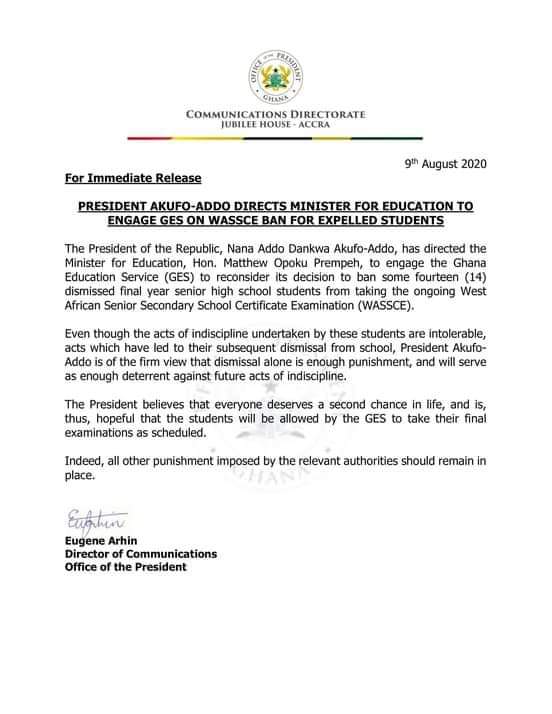
President Nana Addo Dankwa Akufo-Addo has directed the Minister of Education, Matthew Opoku-Prempeh, to engage the Ghana Education Service (GES) to reconsider the punishment meted out to 14 Senior High School students taking the 2020 West Africa Senior School Examination (WASSCE).

The GES last week dismissed the 14 final year students who took part in chaos and destruction of properties in their schools after the Intergrated Science 2 paper of the ongoing WASSCE.

They were also banned from taking the rest of the papers in the final year examination.

The GES in a statement said the punishment was to serve as deterrent to other students who are still partaking in the exams.

But a statement issued on Sunday, August 9, 2020, by the Director of Communications at the Office of the President, Eugene Arhin, said even though the acts of indiscipline by the students are intolerable, the President is of the view that the dismissal alone is enough punishment.

“The President believes that everyone deserves a second change in life, and is thus, hopeful that the students will be allowed by the GES to take their final examinations as scheduled,” the statement explained.

Before the statement from the Presidency on Sunday, various institutions and individuals, including a former Deputy Minister for Education, Samuel Okudzeto Ablakwa, had said the GES was too harsh in the punishment given to 14 students.

The National Democratic Congress MP for North Tongu said although the acts of indiscipline and vandalism are condemnable, the GES seems to have killed an ant with a sledgehammer.

Watch Video of students below>>>

Source:www.ghanaweb.com

Horrifying execution of Prince Klaas, the Ghanaian who planned to make Antigua an African state

Every October 22, the people of Antigua and Barbuda celebrate the execution of Kwaku

Of the over 12 million slaves that were captured from Africa to work on the huge plantations in the Americas, a little over 4 million of them spent their lives working in the Caribbean and close to a million of them were on the island of Antigua breaking their backs on the several sugar cane plantations that were making sugar merchants the richest traders in the world at the time.

After the discovery of the Caribbean and its favourable weather condition, sugar cane plantations owned by the Danes, Spanish and British quickly sprung up. At the time, sugar was a luxurious and expensive commodity imported from India in small quantities.

The discovery of the Caribbean, especially the great weather in the Antigua and Barbuda island changed all that and made sugar the most profitable business in the world. The increase of plantations led to more demand for slaves hence more captives coming from Africa working non-stop under harsh weather conditions with little or no food and rest.

In 1704, 10-year-old Kwaku was captured form Gold Coast, West Africa which is today Ghana during the massive Eguafo Civil war after the death of King Takyi Kuma, a few years after the end of the Kommenda wars. The several wars that happened in the Gold Coast between the 1680s and 1700s was an advantage to the Danish and British slave traders who captured as many as possible and sold them off to slavery.

After being captured, Kwaku was shipped to the Caribbean and was immediately purchased by Thomas Kerby, a rich and prominent sugar planter. At a young age, Kwaku exhibited strength and bravery standing up to white supervisors who harassed him or any of his friends.

Among the planters, he soon became known as Court, pronounced Klaas by the enslaved Africans on the island. By 1720, Thomas Kerby, who had been offered a lot of money in exchange for Kwaku, instead, gave the strong Ghanaian man the title of ‘Head Slave’ putting him in charge of his biggest and most lucrative plantation in St. Johns, Antigua. This gave Kwaku the name Prince Klaas among the enslaved Africans.

After working several years with nothing to his name, Kwaku got fed up and decided to free himself and all slaves who had served white planters for several years. By the late 1720s, the treatment of slaves in Antigua was very horrifying as many were burnt to death, lynched, whipped to death or starved to death for committing an offence, demanding better treatment or secretly getting married to female sexual interests of white planters and merchants.

In 1728, Kwaku came up with a plan to rid the island of all westerners, abolish slavery and make the island of Antigua an African state. After figuring out a great way to execute his plan, he shared details with several like-minded slaves who helped him develop his plan. The strategy took 8 years to plan and in 1736 was ready to be carried out.

The plan was that, in late October of 1736, during a grand ball for the westerners in honour of George II’s coronation, a 10-gallon barrel of gunpowder would be smuggled into the building and blown up killing every single westerner at the ball. The sound of the explosion was to be an alert for several allied enslaved Africans to start killing every white they came across causing a general massacre and the enthroning of Kwaku as leader of the new African Kingdom.

The plan was well hatched and more than ten huge plantations were involved in the plan. During an Akan ceremony at one of the planning meetings, Kwaku was initiated as King of the black community.

Unfortunately for Kwaku and his allies, the plan was leaked to several slave masters by a slave who stayed anonymous for his own safety. The ball was postponed and Kwaku and several of his allies were captured.

After evidence was found against Kwaku and his captured men, they were sentenced to execution through horrifying means. The executions were meant to be slow and painful, done publicly to deter other Africans on the island from planning rebellions.

From early November till Christmas of 1736, Kwaku and his men were executed one after the other in groups. The killings came to a stop during the Christmas period and continued until March 8, 1737.

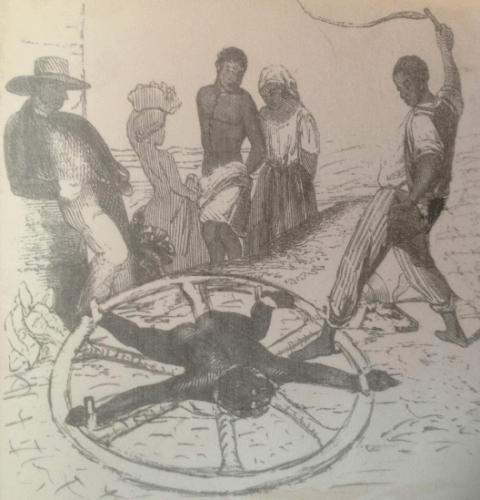
Kwaku and five other leaders of various plantations were executed by “breaking on the wheel” – a horrifying death sentence that was a form of crucifixion. His body was strapped to a cartwheel and spun while an executioner stroked his body until he died. Before being wheeled to death, he was severely lashed while tied to the cartwheel. Six others were hanged on iron and left to starve to death while 77 others were burnt to death.

If successful, the “Antigua’s Disputed Slave Conspiracy of 1736”, as it is popularly known, would have possibly sparked the beginning of African rule outside of the African continent.

Every October 22, the people of Antigua and Barbuda celebrate the execution of Kwaku whose name has been established as Prince Klaas. In St Johns, a monument of Prince Klaas/King Court stands in the town and was built by Sir Reginald Samuel. At the Museum of Antigua and Barbuda, art and history of Prince Klaas are on exhibition. 2018 marked the 282nd anniversary of Prince Klaas’s execution.

Source: face2faceafrica.com

Design a site like this with WordPress.com
Get started